
Bank selection
Direct contact with corporate and personal banking desks at the major Belarusian banks. We match the client to the institution most likely to onboard the profile efficiently.

Banking in Belarus for foreign clients: a workable process
Belarusian banks still welcome foreign companies and foreign individuals. However, onboarding now follows a more deliberate path. First, banks run substantive AML and KYC checks. Next, they ask for a written rationale for the account. Then they screen ultimate beneficial owners against international sanctions and PEP lists. Meanwhile, the National Bank of the Republic of Belarus (NBRB) sets the currency control rules that govern cross-border transactions once the account goes live.
For an international client, the real question is not whether a Belarusian account is possible. It is. Instead, the question is how to choose the right bank, prepare the right documents, and clear onboarding without weeks of back-and-forth. As a result, we work with the corporate desks of the major Belarusian banks regularly and structure each engagement around that diligence.
We work with two categories of non-resident clients:
Both tracks are addressed on this page in general terms. The specific documentary requirements, eligible identification, and onboarding timelines for each category are covered on dedicated pages — links throughout the text.
Two tracks, shared architecture
The corporate and the private path share the same regulatory architecture — same KYC framework, same sanctions screening, same NBRB currency control regime — but differ materially in documentation, bank selection, and timeline.
For corporates, the workload sits in the constituent and authority documentation: charter, registration extract, beneficial ownership disclosure, signing powers, apostille, legalisation, and notarised translation. For private clients, the documentary set is shorter, but the source-of-funds dialogue is more detailed and the choice of bank narrower. We provide each as a separate, focused service rather than a single composite offering.
Open a business account in Belarus without a local entity.
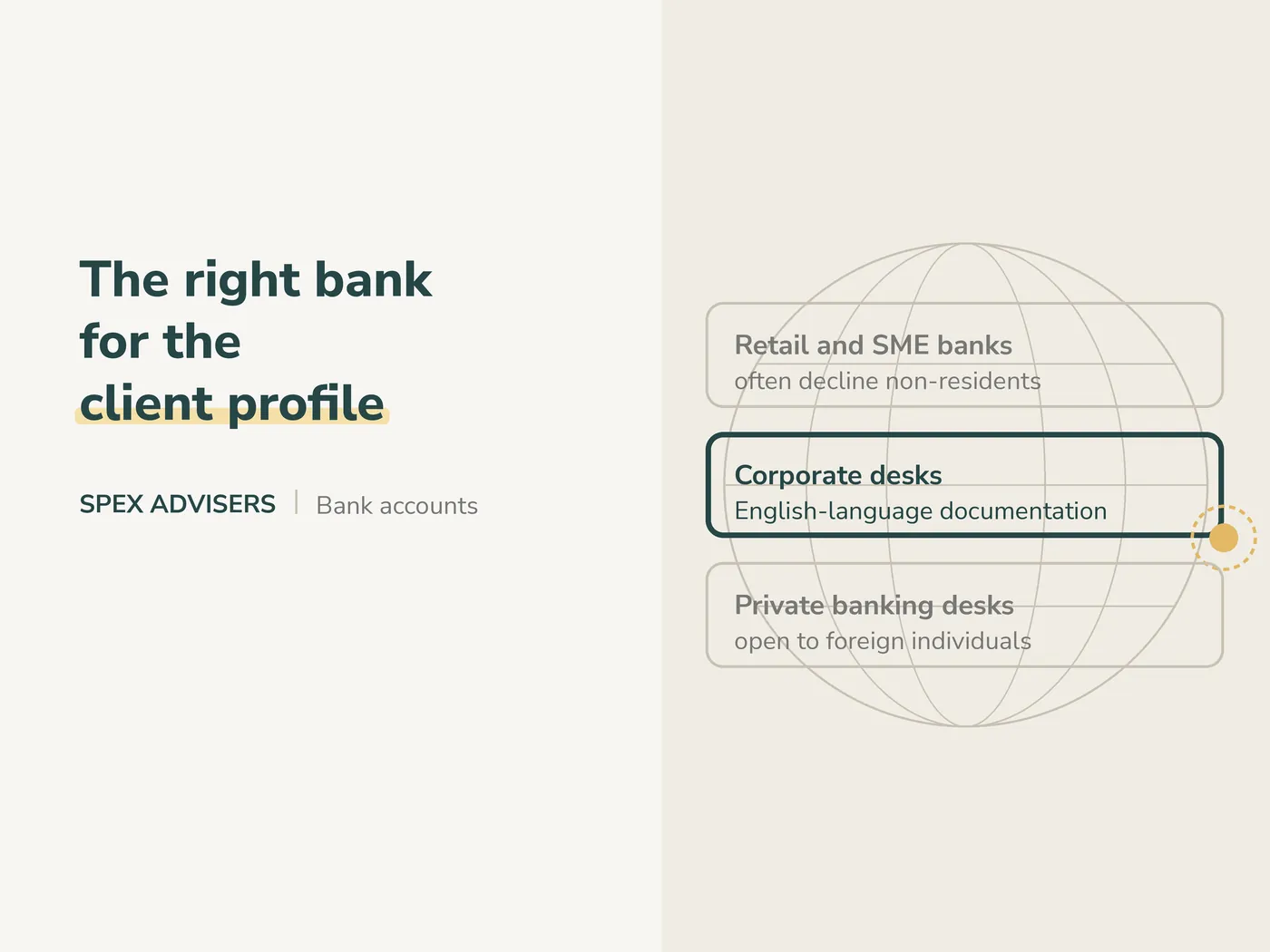
Not every Belarusian bank handles non-resident applicants in the same way. Some focus on retail and domestic SMEs and decline non-resident applications outright. Others maintain dedicated corporate desks with English-language documentation, experience in cross-border structures, and active correspondent relationships with banks in the EU, UAE, and Asia. A smaller group is open to private clients without a Belarusian residence permit.
Bank selection is the single largest determinant of onboarding speed. We match the client’s profile — jurisdiction, ownership structure, expected currencies, geography of counterparties — to the institution most likely to complete onboarding without unnecessary cycles.
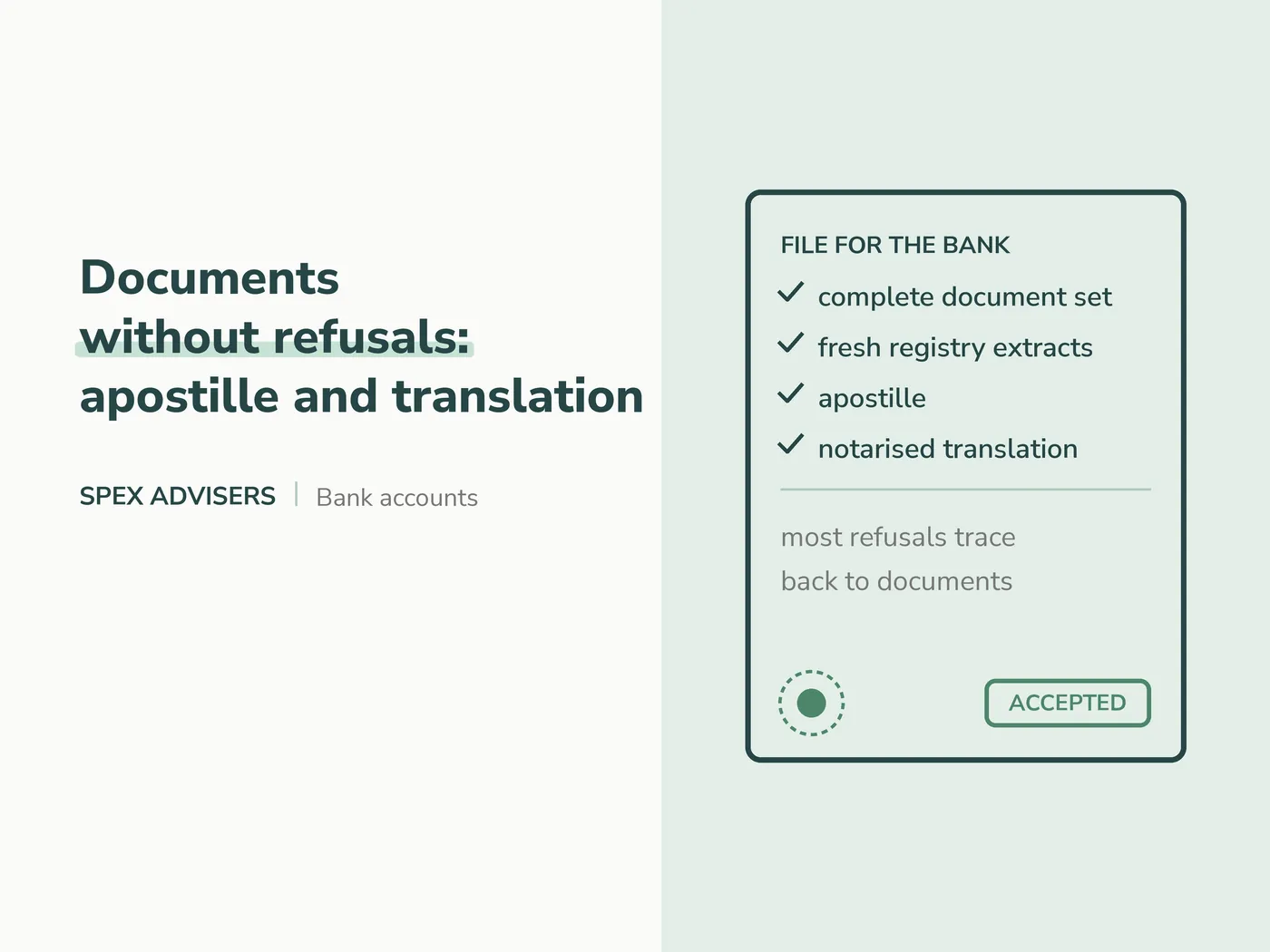
Most refusals trace back to documents — incomplete sets, expired extracts, missing apostilles, unverified translations.
For non-resident corporates, banks typically require constituent documents from the home jurisdiction, registration extracts, evidence of signing authority, identification of beneficial owners, apostille or consular legalisation, and notarised translation into Russian or Belarusian. For non-resident individuals, the documentary set is shorter, but the source-of-funds dialogue is more detailed.
We prepare the application in coordination with the client’s home counsel, manage the legalisation chain end-to-end, and submit a file the bank can review without follow-up requests.
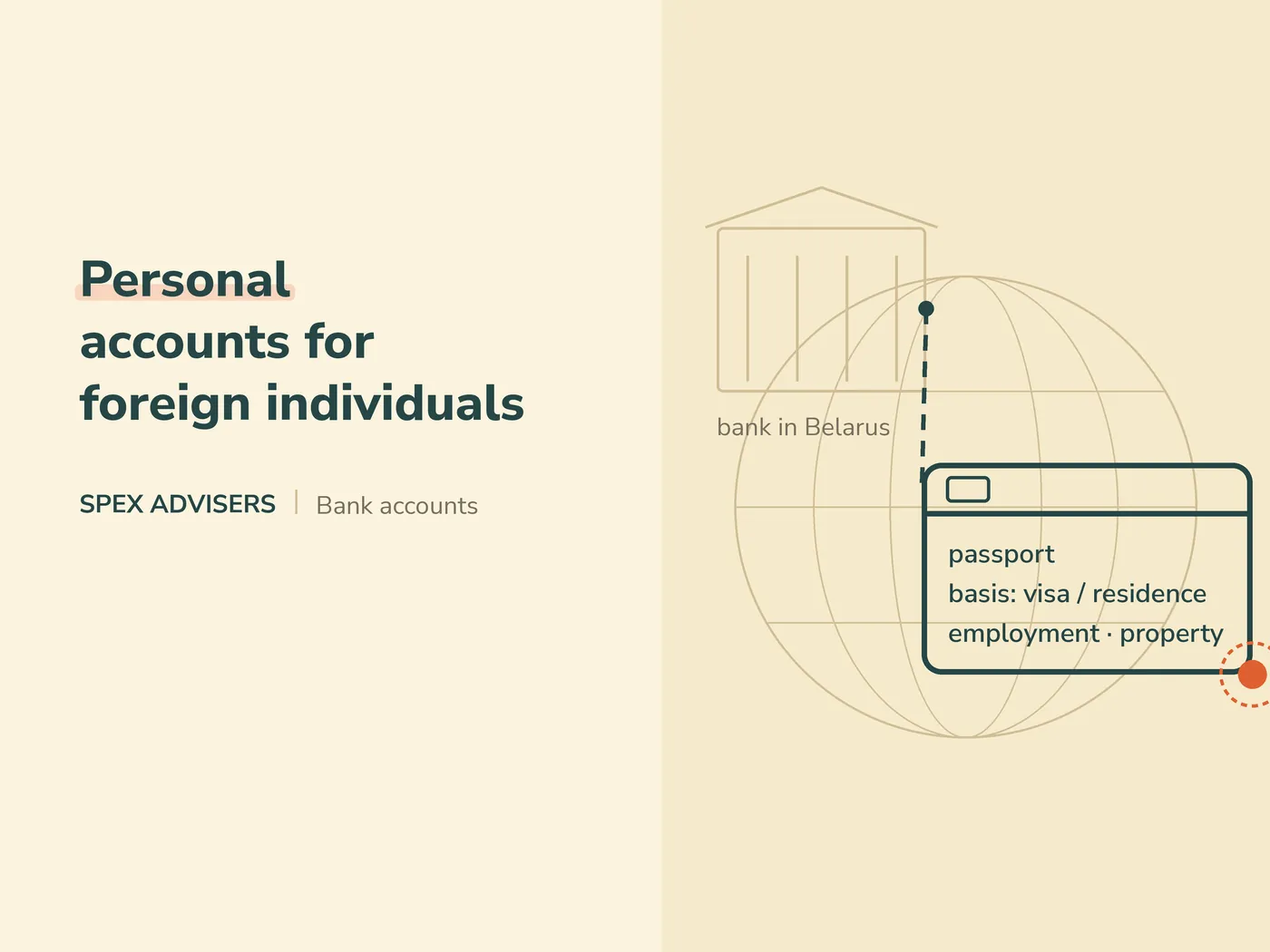
Foreign citizens open personal accounts in Belarus for a range of reasons: employment with a local entity, the purchase of property, family circumstances, or longer-term residence. The application centres on identification, the basis of residency or visa, and — where relevant — confirmation of the source of funds. Documents issued in other languages require a notarised translation into Russian or Belarusian.
The detailed requirements, eligible identification documents, and current onboarding timelines for foreign individuals are covered on the dedicated page.
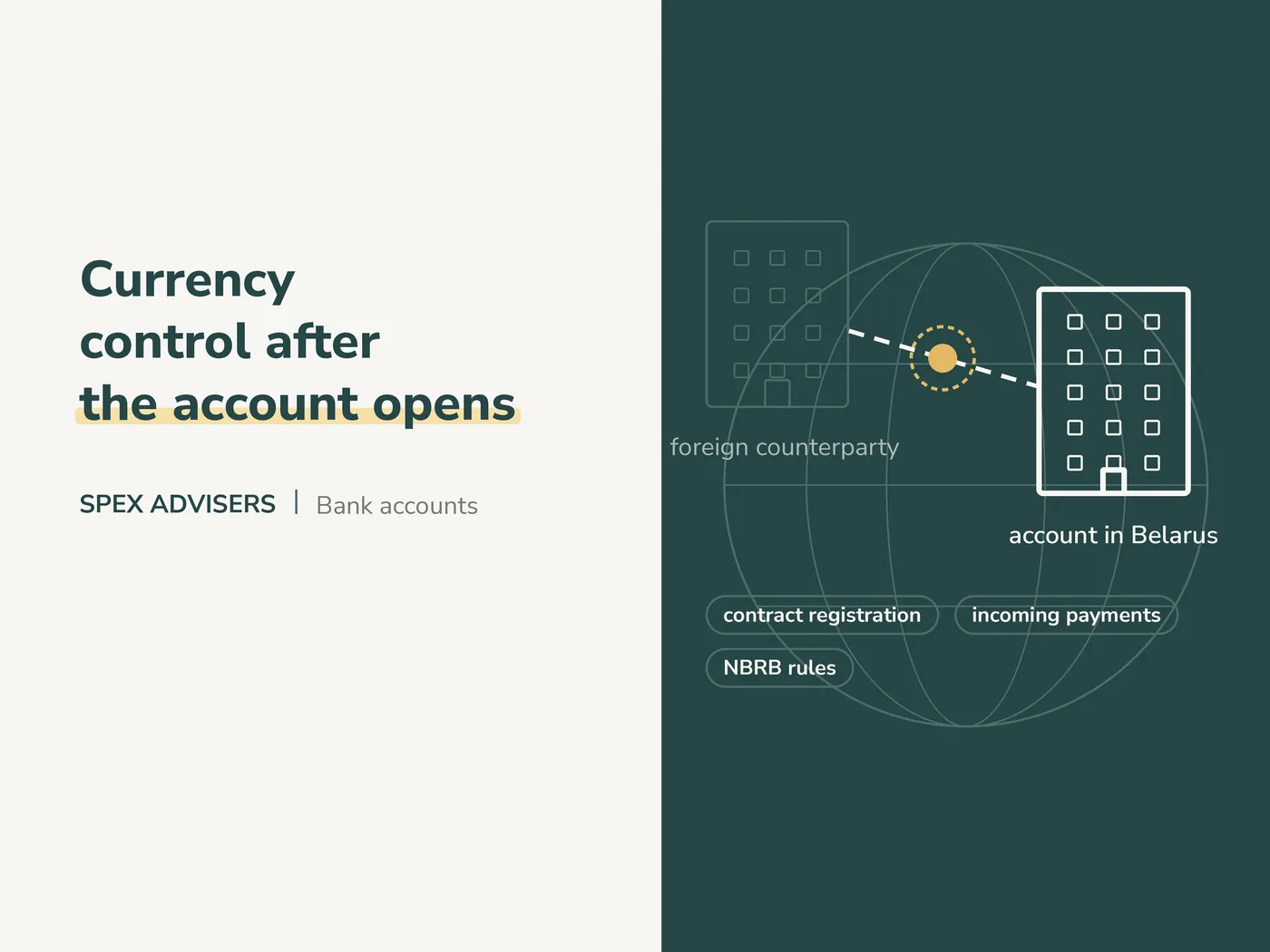
Account opening is the start of the relationship, not its conclusion. Cross-border payments are subject to currency control rules administered by the NBRB: certain contracts above defined thresholds require registration before settlement, transactional documentation must accompany incoming and outgoing flows, and statutory reporting applies to specific categories of transfers.
For account holders connected to a Belarusian operating entity, the currency control layer runs in parallel with corporate accounting and tax reporting. We handle the ongoing compliance — transaction documentation, contract registration, reporting — under the same contract as the onboarding itself.
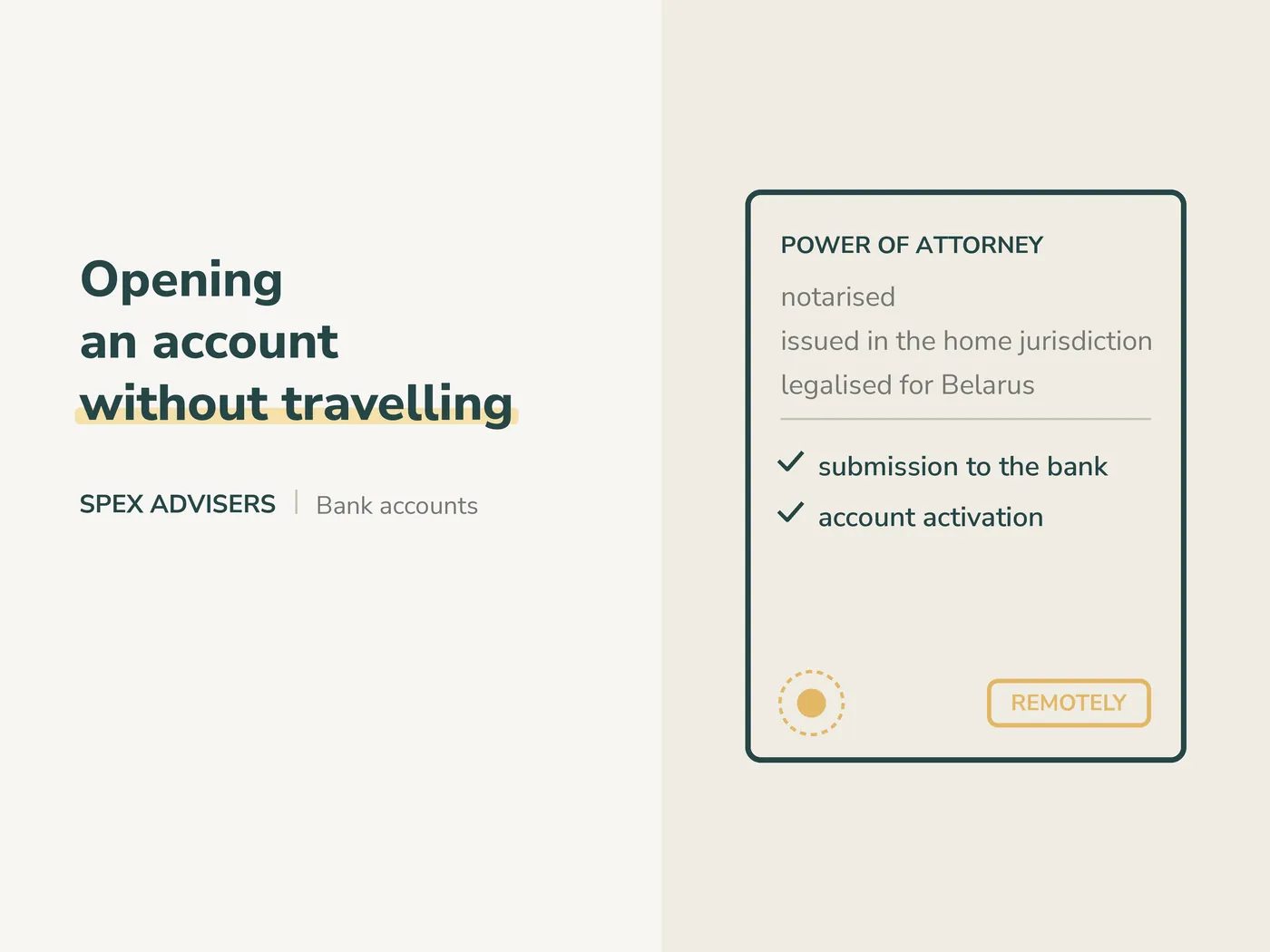
Most Belarusian banks require the authorised signatory or the individual account holder to be physically present at the time of onboarding. For clients who are unable to travel, the engagement is based on a notarised power of attorney issued in the client’s home jurisdiction and legalised for use in Belarus. Under that mandate, our representative attends the bank, signs the specimen card and completes the onboarding process on the client’s behalf.
The arrangement is compliant with NBRB requirements and is used routinely by clients in the US, UK, EU, UAE, and Asia. The power of attorney is drafted to the specific bank’s expectations to avoid rejection at the counter.
Accounting, payroll, and statutory reporting in Belarus.
Yes. Both non-resident legal entities and non-resident individuals can open accounts. The applicable bank, documentary set, and timeline differ between the two categories and depend on the client’s specific profile.
Not necessarily. Most onboardings can be completed under a notarised and legalised power of attorney issued in the client’s home jurisdiction. Some banks prefer at least one in-person visit at the start of the relationship; we identify this at briefing.
The major Belarusian banks offer accounts in Belarusian rubles, US dollars, euros, and a selection of additional currencies. The exact list depends on the bank.
For a non-resident, the usual onboarding window is three to eight weeks. Several factors shape it — the bank in question, the complexity of the ownership structure, and the pace of legalisation in the home jurisdiction. Whatever the case, we agree a written timeline with you at briefing.
Yes. There is no statutory restriction on the number of banks or accounts a single account holder can use.
Belarusian banks notify the tax inspection of new corporate accounts as part of the standard procedure. Personal accounts are not automatically reported to the tax authorities by the bank, though tax obligations apply to the account holder as a matter of substantive law.
A refusal is not always the end of the road. We examine the reason behind it, address that reason wherever possible, and then either resubmit or redirect the application to a bank better suited to your profile. Most first-submission refusals come down to documentation; outright bank-level rejections are less common, but they do happen, and we handle each one on a case-by-case basis.

A lot of IT group companies write their code in Minsk and keep the intellectual property somewhere else: a holding company in Cyprus or the Netherlands, the US parent, or a hub in the UAE. When the Belarusian company uses that IP to earn money, the group usually wants a royalty to flow back to […]

Most foreign groups with a team in Belarus charge the local company for head-office support: finance, HR, legal, IT, and sometimes a share of senior management time. The logic is sound. The Belarusian entity uses those services, and someone has to pay for them. Problems start when the tax office asks for evidence. A management […]

Most foreign founders arrive in Belarus with an audit rule of thumb borrowed from home. In the EU, small companies are usually exempt, while in some jurisdictions every subsidiary is audited. Neither assumption holds in Minsk. Belarusian law decides who needs a statutory audit by status, size and a handful of specific events — not […]